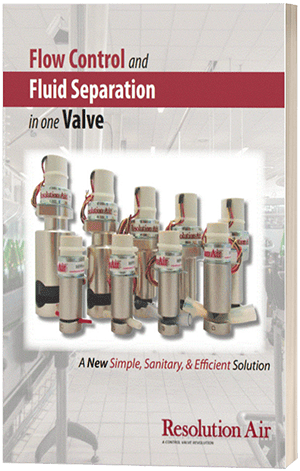
Selecting the Right Valve for Your Application
Choosing a proportional pinch valve depends on several application-specific factors. While all proportional pinch valves provide continuous control and maintain a fully isolated fluid path, the optimal configuration depends on system requirements such as flow characteristics, tubing selection, and control precision.
This page outlines the key considerations to help guide your selection.
Key Factors to Consider
Flow Rate and Control Range
The required flow rate is one of the primary factors in selecting a valve. Low-flow applications requiring fine control typically use smaller valve configurations, while higher flow systems require valves capable of handling larger volumes and broader control ranges.
Tubing Characteristics
Because proportional pinch valves operate by compressing tubing, the size and material of the tubing directly affect valve performance. Larger tubing requires more force to regulate flow, while smaller tubing enables finer control.
Control Accuracy
Applications requiring accurate dosing or repeatable flow rates benefit from high-resolution control. The level of precision required should be considered when selecting a valve configuration.
Pinch Force Needed
The force required to compress tubing varies depending on tubing size and material. Systems requiring greater force to regulate flow typically require valve configurations designed for higher force output.
Control and Automation Requirements
Consider how the valve will integrate into your system, including control signals, automation requirements, and compatibility with existing components.
Selecting Between M Series and H Series
M Series Miniature Valves
M Series valves are typically used for applications requiring precise control in compact systems. They are best suited for low-flow environments where accuracy and space constraints are primary considerations.
Common Use Cases:
- Low-flow fluid metering
- Laboratory and analytical systems
- Compact system designs
H Series Hybrid Valves
H Series valves are designed for applications requiring greater force and support for larger tubing sizes. They are used in systems where higher flow rates or more demanding operating conditions are present.
Common Use Cases:
- Higher flow fluid control
- Larger tubing systems
- Bioprocessing applications
- Industrial fluid handling
Quick Selection Guide
Use the following as a general guideline:
- If your application requires low-flow, high-precision control → M Series is typically appropriate
- If your application requires higher flow or larger tubing → H Series is typically appropriate
- If your requirements are unclear or variable → further evaluation is recommended
When to Evaluate a Valve in Your System
In applications where performance must be validated under real operating conditions, evaluating a valve within your system can provide clarity. This is particularly useful when system requirements are complex or when precise performance must be confirmed before implementation.
Applications Requiring Careful Valve Selection
- Precision fluid metering systems
- Bioprocessing and sanitary fluid handling
- Laboratory and analytical instrumentation
- Chemical dosing systems
Need Help Selecting a Valve?
If your application requirements are complex or you need guidance selecting the appropriate valve configuration, support is available to help you determine the best solution based on your system.